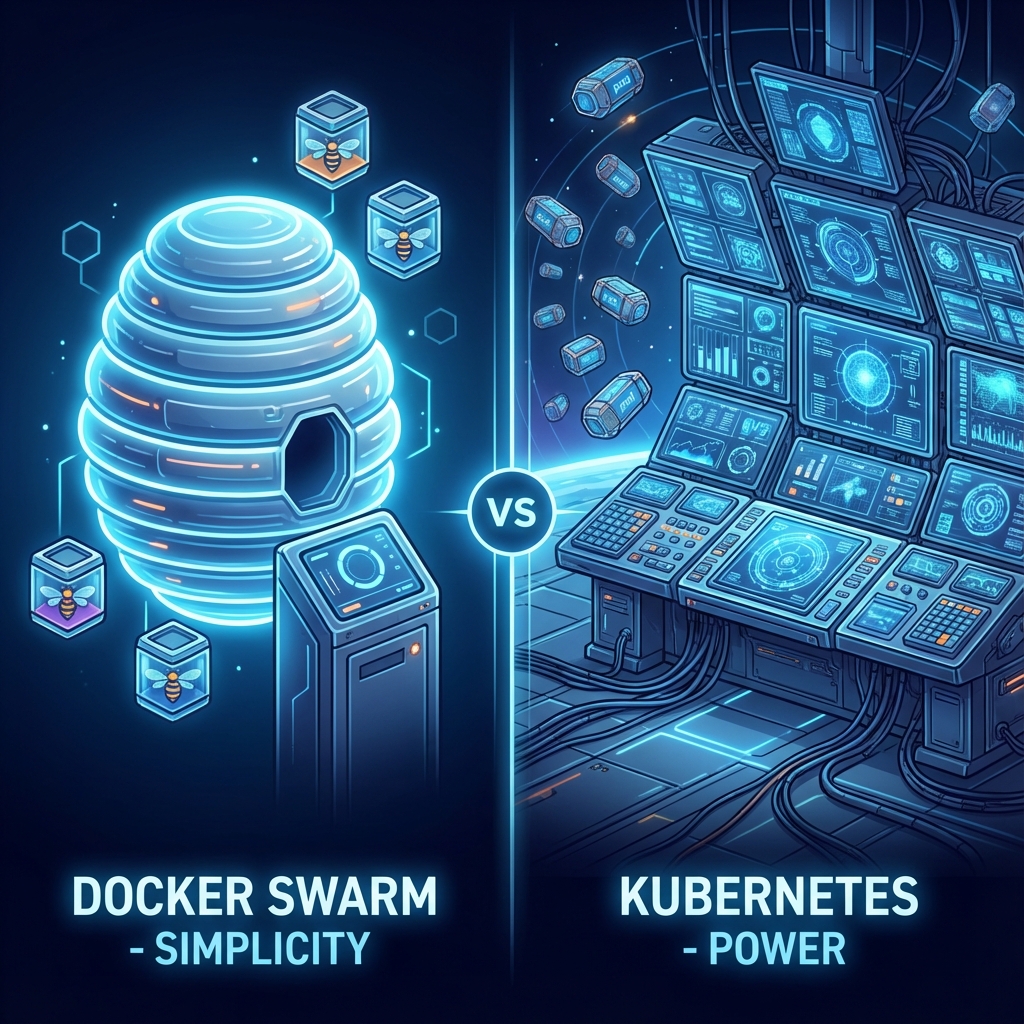
Docker Swarm vs Kubernetes: Is Swarm Dead in 2025?
In the world of container orchestration, Kubernetes (K8s) has seemingly won the war. It is the industry standard for enterprise-grade deployment, offering immense power and extensibility. However, it comes with a steep learning curve and significant operational complexity.
On the other hand, Docker Swarm remains a strong contender, often dismissed as "dead" or "legacy." Yet, it continues to power thousands of edge devices, homelabs, and startup infrastructures.
Why does Swarm refuse to disappear? Because simplicity is a feature.
This article analyzes the trade-offs between Docker Swarm and Kubernetes in 2025, helping you decide which orchestration tool fits your infrastructure needs.
Part 1: The Simplicity Gap
The Kubernetes "Hello World"
To run a scalable web server on K8s, you need:
- Deployment YAML: Defines the pods/replicas.
- Service YAML: Defines the internal networking.
- Ingress YAML: Defines the external access (Nginx/Traefik).
- ConfigMap/Secret: Injection of env vars.
You also need a Control Plane (API Server, Etcd, Scheduler, Controller Manager) which eats ~2GB of RAM just to sit idle.
The Docker Swarm "Hello World"
docker-compose.yml:
services:
  web:
    image: nginx
    deploy:
      replicas: 3
    ports:
      - "80:80"
- Run:
docker stack deploy -c docker-compose.yml myapp
Done. It uses the exact same file format developers use locally. It needs ~50MB of RAM overhead.
Part 2: Architecture comparison
Docker Swarm
Swarm Mode is built into the Docker Engine. You don't install it. You activate it.
- Topology: Managers (Raft Consensus) + Workers.
- Store: Distributed internal store (encrypted by default).
- Networking: Overlay Network (VXLAN) creates a flat mesh. You can ping
webfrom any container. - Security: Mutual TLS (mTLS) between nodes is Auto-Configured and rotated every 90 days.
Key Advantage: Zero-config security. In K8s, setting up mTLS requires a Service Mesh (Istio/Linkerd), which is a beast to manage.
Kubernetes
K8s is a platform for building platforms.
- Topology: Separate Control Plane nodes + Worker nodes.
- Store: Etcd (External key-value store). Highly sensitive to disk latency.
- Networking: CNI (Container Network Interface). You must choose a plugin (Calico, Cilium, Flannel).
- API: CRDs (Custom Resource Definitions). You can extend the API. "I want a
PostgresDatabaseobject."
Key Advantage: The Ecosystem. Helm Charts, Operators, ArgoCD. The tooling is infinite.
Part 3: The Operator Problem (Why K8s Won)
The reason K8s won the enterprise is the Operator Pattern. In Swarm, a database is just a container. If the primary dies, Swarm restarts it. It doesn't know how to promote a Replica to Primary.
In K8s, a Postgres Operator watches the cluster.
- Primary dies? The Operator code runs, promotes the replica, reconfigures the backup, and alerts the team. K8s allows "Application Logic" in the infrastructure layer. Swarm is just "dumb" process management.
Part 4: The K3s Threat
For years, Swarm's defense was "K8s is too heavy for IoT/Edge." Then came K3s (from Rancher).
- A single binary (<100MB).
- Replaces Etcd with SQLite.
- Strips out legacy cloud providers.
K3s allows you to run Kubernetes on a Raspberry Pi. It eroded Swarm's last major stronghold (Edge Computing). However, K3s is still Kubernetes. It still has the YAML verbosity.
Part 5: Operational Reality
Scenario: Cluster Upgrade
- Swarm:
apt-get upgrade docker-ce. Nodes drain and reconnect automatically. - Kubernetes: Drain node. Cordon node. Upgrade Kubelet. Uncordon. Upgrade Control Plane. Verify Etcd health. Pray. (Or just use a Managed Service like EKS).
If you are a team of 3 devs without a dedicated DevOps person, Self-Hosted Kubernetes will kill you. Managed Kubernetes (EKS/DOKS) costs money ($70/mo for control plane). Swarm costs $0.
Part 6: When to use what?
Stick with Docker Swarm if:
- Small Team: You want to deploy "Git Push to Prod" without learning 50 new concepts.
- Simple App: Just a Stateless Web App + Redis + Postgres.
- Low Cost: You run on $5 VPS instances.
- Legacy: You are already using Docker Compose. Swarm is just Compose across servers.
Switch to Kubernetes if:
- Complexity: You need CRDs, Operators, or complex StatefulSets.
- Scale: You have 50+ microservices and 100+ nodes.
- Hiring: It is easier to hire a "Kubernetes Engineer" than a "Swarm Expert" in 2025.
- GitOps: You want to use ArgoCD / Flux for true CD.
Conclusion: Swarm is the "SQLite" of Orchestration
SQLite is not "dead" because Oracle exists. It serves a different purpose. Docker Swarm is the SQLite of orchestration. It is embedded, simple, and sufficient for 80% of use cases. Kubernetes is the Oracle. Powerful, scalable, and heavy.
Don't feel shame for using Swarm. Complexity is the enemy of reliability. If Swarm solves your problem, using Kubernetes is just resume-driven development.